
The Ideal Logic Combi boiler is a highly efficient and reliable heating solution, providing on-demand hot water and central heating for modern homes.
What is an Ideal Logic Combi Boiler?
The Ideal Logic Combi boiler is a condensing combination boiler, meaning it’s both highly efficient and compact. Unlike traditional boiler systems requiring separate hot water tanks, a combi boiler heats water on demand, delivering hot water directly to your taps. This eliminates energy waste from constantly heating a large water volume.
Ideal Logic boilers are known for their reliability and user-friendly operation. They come in a range of outputs (kW) to suit different home sizes and hot water demands. The ‘Logic’ range represents a popular choice for homeowners seeking a dependable and cost-effective heating system. They are designed for straightforward installation and maintenance, contributing to their widespread appeal.
Key Features and Benefits
The Ideal Logic Combi boasts several key features, including high efficiency condensing technology, reducing gas consumption and lowering heating bills. Its compact design allows for flexible installation options, even in smaller homes. The user-friendly interface simplifies operation and programming.
Benefits include instant hot water, eliminating wait times, and space-saving due to the absence of a separate hot water tank. The boilers are generally quiet in operation and offer a range of power outputs to match household needs. Regular servicing ensures optimal performance and longevity, maximizing your investment. Furthermore, Ideal boilers often come with extended warranties for added peace of mind.

Understanding Your Boiler’s Control Panel
The control panel displays vital information through symbols and indicators, allowing users to monitor boiler status and adjust settings easily.
Display Symbols and Indicators
The Ideal Logic Combi boiler’s display panel utilizes a range of symbols to communicate its operational status. A constant flame symbol indicates normal operation, while a flashing flame suggests ignition issues or flame loss. The water tap symbol signifies hot water demand, and a central heating symbol shows when heating is active.
Temperature readouts display the flow and return temperatures, crucial for diagnosing overheating or low-flow problems. Error codes, prefixed with ‘L’ or ‘F’, are displayed to pinpoint specific faults, requiring reference to the user guide for interpretation. A frozen snowflake symbol indicates potential freezing conditions, prompting preventative measures. Understanding these indicators empowers users to quickly assess the boiler’s condition and address potential issues promptly.
Operating Modes (Heating, Hot Water, Off)
The Ideal Logic Combi boiler offers three primary operating modes: Heating, Hot Water, and Off. In Heating mode, the boiler provides warmth to your radiators, controlled via the thermostat. Hot Water mode delivers instant hot water to your taps, activated by demand. The ‘Off’ mode completely shuts down the boiler, conserving energy when heating and hot water aren’t needed.
Switching between modes is typically done through the control panel buttons. Some models allow scheduling for automated operation. Understanding these modes allows for efficient energy usage and tailored comfort. Remember to consult your specific model’s manual for detailed instructions on mode selection and programming.

Common Ideal Logic Combi Boiler Fault Codes
The Ideal Logic Combi boiler utilizes fault codes to diagnose issues, ranging from low pressure (F1) to flame loss (L2) and overheat (L1).
L1: Flow Temperature Overheat/No Water Flow
The L1 fault code on an Ideal Logic Combi boiler indicates either the flow temperature is excessively high, or critically, there’s no water flow detected within the system. This triggers a safety shutdown to prevent damage. Initial troubleshooting involves bleeding radiators thoroughly to eliminate any trapped air, potentially causing blockages.
Next, verify the system pressure is within the recommended range (typically around 1.0 to 1.5 bar) and top up if necessary. Ensure all radiator valves and the boiler valves are fully open, allowing unrestricted water circulation. If the issue persists after these checks, a reset of the boiler might resolve a temporary sensor error. However, persistent L1 errors often suggest a more significant problem, like a pump failure or a blockage within the heat exchanger, necessitating professional attention from a qualified heating engineer.
L2: Flame Loss/Ignition Lockout
The L2 fault code on your Ideal Logic Combi boiler signifies a loss of flame during operation, or a failure to ignite the burner after multiple attempts – an ignition lockout. This is a safety feature preventing gas buildup. First, check the gas supply to ensure it’s turned on and functioning correctly. A simple boiler reset can sometimes clear a temporary issue, allowing the system to re-attempt ignition.
However, recurring L2 errors often point to more complex problems. These could include a faulty ignition electrode, a failing gas valve, or issues with the flame detection sensor. A blocked flue can also disrupt combustion. Do not attempt to repair these components yourself; contact a Gas Safe registered engineer immediately for diagnosis and repair. Ignoring this fault could lead to dangerous gas leaks.
F1: Low Water Pressure
The F1 fault code on your Ideal Logic Combi boiler indicates that the system water pressure has dropped below the minimum operating level, typically around 0.5 to 1.0 bar. This prevents the boiler from functioning correctly and can trigger safety shutdowns. First, check the boiler’s pressure gauge – it’s usually located on the front panel. If the pressure is low, you may need to repressurise the system.
Locate the filling loop (usually near the boiler) and carefully follow the instructions in your boiler manual to increase the pressure. If you are unsure about this process, or the pressure continues to drop, contact a qualified Gas Safe engineer. A persistent loss of pressure could indicate a leak somewhere in the heating system, requiring professional attention.
F2: Flame Loss Detected
The F2 fault code signals that your Ideal Logic Combi boiler has detected a loss of flame during operation. This means the boiler ignited initially, but the flame unexpectedly extinguished. Several factors can cause this, including a faulty gas supply, a problem with the ignition system, or a blocked flue. Attempting a boiler reset is the first step; however, if the fault persists, it indicates a more serious issue.
Do not repeatedly attempt to reset the boiler, as this could be dangerous. A qualified Gas Safe engineer needs to investigate the cause, checking the gas supply, ignition components, and flue for obstructions. Ignoring this fault could lead to incomplete combustion and the release of carbon monoxide.
F3: Fan Fault
The F3 error code on your Ideal Logic Combi boiler indicates a problem with the fan, crucial for providing combustion air and expelling exhaust gases. This fault can stem from a blocked fan, a faulty fan motor, or wiring issues. A malfunctioning fan compromises the boiler’s safe and efficient operation, potentially leading to incomplete combustion and carbon monoxide production.
Initially, try resetting the boiler. If the F3 code reappears, do not attempt further troubleshooting yourself. Contact a qualified Gas Safe engineer immediately to diagnose and repair the fan issue. They will check for obstructions, test the fan motor, and inspect the wiring connections to restore safe operation.
F4: Flow Thermistor Fault
The F4 error code signals a problem with the flow thermistor within your Ideal Logic Combi boiler. This component measures the temperature of the water leaving the boiler, providing vital data for efficient operation. A faulty thermistor can lead to inaccurate temperature readings, causing the boiler to operate inefficiently or shut down as a safety precaution.
This fault often requires professional attention. Do not attempt to replace the thermistor yourself. A qualified Gas Safe engineer will diagnose the issue, potentially replacing the faulty thermistor or investigating related wiring problems. Accurate temperature sensing is critical for safe and reliable boiler performance, so prompt repair is essential.
F5: Return Thermistor Fault
The F5 fault code on your Ideal Logic Combi boiler indicates a problem with the return thermistor. This sensor monitors the temperature of the water returning to the boiler after circulating through your heating system. Accurate return temperature readings are crucial for the boiler’s efficiency and safe operation, helping it modulate heat output effectively.
Like the flow thermistor fault, resolving an F5 error typically requires a qualified Gas Safe engineer. They will diagnose the issue, potentially replacing the faulty sensor or checking the associated wiring. Ignoring this fault can lead to inefficient heating and potential boiler damage, so professional attention is recommended promptly.
F6: False Flame Lockout
The F6 fault code on an Ideal Logic Combi boiler signifies a ‘false flame lockout’ situation. This means the boiler has detected what it believes is a flame when none is actually present, or it’s repeatedly attempting ignition without success, triggering a safety shutdown.
Several factors can cause this, including a faulty flame detection sensor, issues with the gas supply, or problems with the boiler’s ignition system. A Gas Safe registered engineer is essential for diagnosing and resolving this fault. Attempting self-repair is dangerous. The engineer will thoroughly inspect the components and restore safe operation, preventing potential gas leaks or further damage.
F7: Low Combustion Air Pressure
The F7 error code on your Ideal Logic Combi boiler indicates a problem with low combustion air pressure. This is a critical safety issue, as sufficient airflow is vital for complete and safe gas combustion. Insufficient air can lead to incomplete combustion, producing dangerous carbon monoxide.
Potential causes include a blocked or restricted air intake, a faulty fan, or obstructions within the flue system. Do not attempt to resolve this yourself. Immediately turn off the boiler and contact a Gas Safe registered engineer. They will inspect the air intake, flue, and fan to identify and rectify the problem, ensuring safe and efficient boiler operation.
Boiler Reset and Troubleshooting
Simple fixes like resetting, bleeding radiators, and checking water pressure can often resolve minor boiler issues before requiring professional assistance.
Performing a Reset
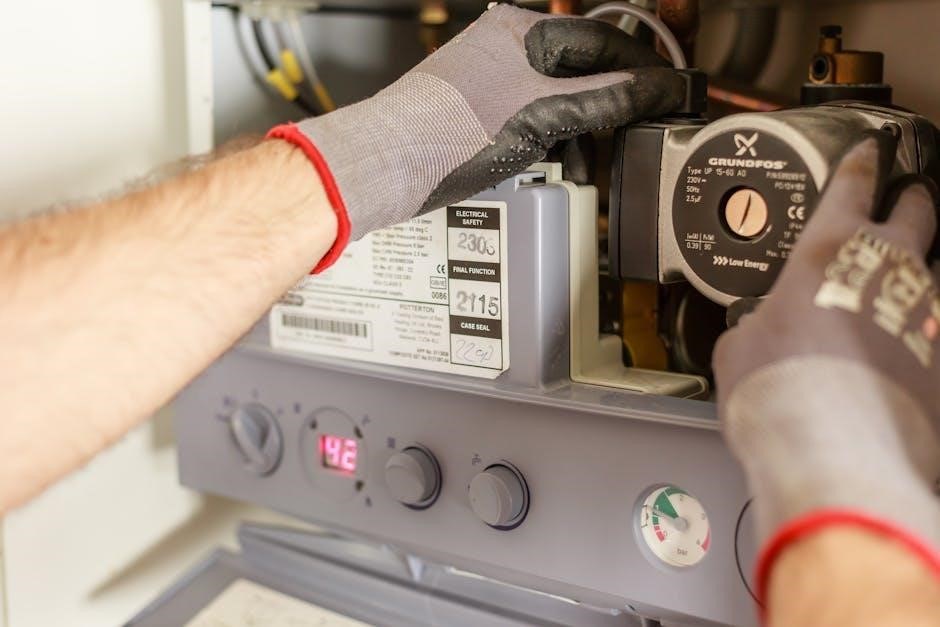
Resetting your Ideal Logic Combi boiler is often the first step in resolving minor faults. Begin by turning off the boiler using the power switch, typically located on the front panel. Allow approximately thirty seconds to pass before switching the boiler back on. This allows the system to fully reset its internal components.
If the boiler continues to display a fault code after a reset, it may indicate a more serious issue. Repeated resets within a short timeframe can also trigger a lockout, requiring a qualified engineer’s intervention. Always consult the boiler’s manual for specific reset instructions related to your model. Remember safety first – if unsure, contact a professional.
Bleeding Radiators
If your radiators are cold at the top but warm at the bottom, they likely contain trapped air. To bleed them, you’ll need a radiator key. Carefully insert the key into the bleed valve, usually located at the top side of the radiator. Slowly turn the key counterclockwise until you hear a hissing sound – this is the air escaping.
Continue releasing air until water starts to drip out. Once water appears, tighten the bleed valve clockwise to stop the flow. Repeat this process for all radiators in your home, starting with those furthest from the boiler. After bleeding, check your boiler’s pressure and top it up if necessary to maintain optimal heating performance.
Checking Water Pressure
Maintaining correct water pressure is crucial for your Ideal Logic Combi boiler’s efficient operation. Locate the pressure gauge on the boiler’s front panel; it typically displays pressure in bars. The ideal pressure usually falls between 1 and 1.5 bar. If the pressure is too low (below 1 bar), the boiler may not function correctly, potentially displaying a fault code like F1.
To increase the pressure, you’ll need to use the filling loop, usually found near the boiler. Open both ends of the loop, allowing water to flow into the system until the gauge reaches the desired level. Then, close both ends of the filling loop. If the pressure is consistently too high, contact a qualified engineer.

Annual Servicing and Maintenance
Regular servicing by a qualified engineer ensures optimal performance, safety, and longevity of your Ideal Logic Combi boiler, preventing costly repairs.
Importance of Regular Servicing
Annual servicing is crucial for maintaining the efficiency and safety of your Ideal Logic Combi boiler. A qualified Gas Safe registered engineer will thoroughly inspect all components, ensuring they function correctly and identifying potential issues before they escalate into expensive repairs. Regular maintenance helps optimize fuel consumption, reducing your energy bills and minimizing your carbon footprint.

Servicing also verifies the safe operation of vital safety devices, such as the flue and carbon monoxide detector, protecting your household from dangerous gases. Ignoring annual servicing can invalidate your boiler’s warranty and potentially lead to a dangerous situation. Proactive maintenance extends the lifespan of your boiler, providing years of reliable heating and hot water.
What Does a Service Include?

A comprehensive Ideal Logic Combi boiler service typically involves a visual inspection of all components, including the heat exchanger, burner, and flue. The engineer will check for any signs of corrosion, leaks, or damage. They’ll also test the boiler’s safety devices, such as the gas pressure and carbon monoxide detector, ensuring they operate within safe parameters.
Furthermore, the service includes cleaning key components to maintain optimal performance and efficiency. The engineer will analyze the combustion process and adjust settings as needed. A flue gas analysis is performed to verify complete combustion and minimize harmful emissions. Finally, they’ll provide a detailed report of their findings and any recommended repairs or maintenance.